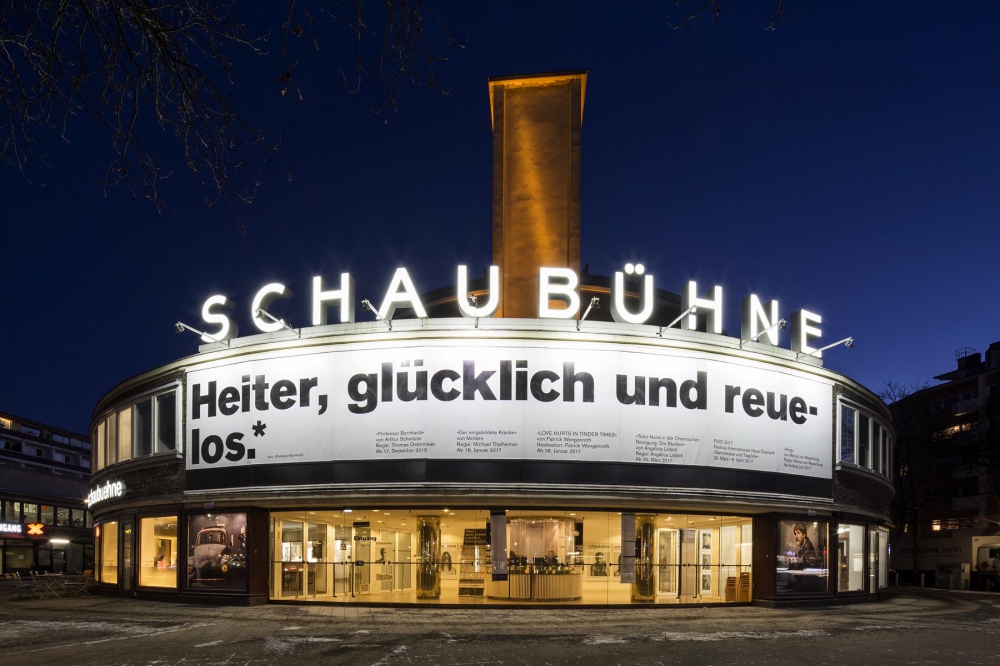
Although the near future might look bright for British theatre since the government’s announcement last week that indoor theatre performances would be allowed from 1st August, the reality is that this announcement, along with the government’s £1.5 billion support package for the arts sector, is still insufficient for securing the long-term future of our theatre industry. This led me to question how British theatre can adapt to survive in the years of uncertainty lying ahead. Although I tend to spend more time watching/reading/talking about/making theatre than I do actually studying for my degree, as a German student and a long-time admirer of German theatre, I researched into the German theatre industry to uncover why the way in which Germany finances its theatres explains how the German theatre industry is increasingly gaining the reputation as a hub of creative diversity and dynamism which formerly belonged to British theatre.
Unlike in the British theatres, German theatres are not just supported through state grants and private sponsors. They are typically directly state funded, in a similar way to other state institutions like hospitals and schools. There are, however, fewer state funded theatres than there are independent theatres- although the latter are still supported through state grants. As of 2020, there are 40 state funded theatres and 220 independent theatres– known as the “Freie Szene”- across Germany. Since the state generously funds so many theatres and provides grants for independent theatres through organisations like the German Federal Cultural Foundation, this means that the German theatre industry is much more evenly distributed across Germany, unlike in the UK. In other words, regional theatre is much stronger. Whereas the British theatre industry is overwhelmingly focused on London, almost every German city and large town has both state-funded and independent theatres. The German financial model ensures that a state funded theatre in a smaller city like Weimar would be funded as well as a major state funded theatre in Berlin, avoiding regional disparities. Something akin to the Southampton Nuffield Theatre shutting down would most likely never have happened. However, what happened to the Nuffield Theatre, and several other British theatres during the pandemic, was merely symptomatic of the endemic lack of funding for regional theatres. The gap between London theatres and theatres elsewhere is growing.
Since the UK government does not directly fund theatres, like many aspects of life in the UK, these public institutions have largely been privatised. Many are also dependent on Arts Council grants. The Arts Council receives funding from the government but is paradoxically a non-governmental body and has experienced several controversies over regional disparities in the awarding of its grants. In theatres outside of London, the lack of sufficient funding available (i.e beyond grants) has forced the majority of regional theatres to avoid taking creative risks- out of fear of losing profits- and instead host touring West End productions as a means to survive. Apart from my local Royal Exchange Theatre, none of the other theatres I have visited in my region have staged their own productions for many, many years. These theatres, once great hubs for creativity in the north of England, have largely been reduced to vessels for touring productions of Shrek the Musical and pantomimes, simply because these productions are guaranteed ticket sellers. Away from London, where the sheer size of the population provides greater reassurance that an audience will be found, all of our most experimental theatre is taking place in fringe venues in other major cities like Manchester, Glasgow and Sheffield, whilst regional theatres remain deprived. Additionally, as so many theatres must seek out private sponsors to additionally fund their productions, the productions themselves must please these sponsors, inhibiting much of the creative freedom which makes theatre such a joy.
In Germany on the other hand, whilst the prolific state funded theatres receive enough money to be able to take more creative risks (although in recent year have still allegedly become increasingly consumer-driven), independent theatres across Germany also gain substantial state grants, meaning they are able to truly push boundaries and produce the experimental theatre for which Germany is famous.
It may seem like the answer is that the British government needs to take note from Germany and start to directly fund more of our theatres. As helpful as that £1.5 billion support package is, it is more like a sticking plaster over a wound which actually needs to be sewn up. According to the UK’s flagship theatre, the National Theatre, public funding for the arts sector makes up only 0.05% of government spending, meaning that our theatre industry has largely become dependent on private sponsors and Arts Council grants. If this system sounds secure in principle, the COVID-19 pandemic has proved that it simply does not work, especially for the regional theatres which have been most hard-hit by the lockdown.
Although part of the financial support for German theatres lies its constitution, which makes the arts the responsibility of the ministry of culture of every German state, the UK does not need to alter its constitution to change its failing approach to funding its theatre industry. By moving to directly fund some theatres, we would hopefully be rewarded with a richer and more diverse theatre scene which extends beyond London, as well as better funded London theatres. If even the National Theatre is seriously struggling in the pandemic, then surely this is a sign that something has to change.
If further proof is needed to warrant changes, the fact that German theatres have not been as severely affected as their British counterparts and are preparing to re-open in the autumn should suffice. This is also because the German government’s overall response to the pandemic was markedly more effective than that of the UK, and the government provided additional support for theatres through a furlough scheme and grants for freelance artists, which further suggests that the German government appears to place greater value in the arts. Our government would do well to learn from the importance of this vital sector.
But perhaps this is all just wishful thinking. The grass might look greener in Germany, but its theatre industry still has its own problems. Nevertheless, I still believe that the German financial model for funding its theatres would be suitable in the UK. It would help our theatres- and regional theatres in particular- to avoid another crisis such as the one that they are currently facing because this pandemic is most likely far from the last which we will see in our lifetimes.
 A Northern Girl in a Southern World